
Flag football positions explained: offense and defense roles
Flag football uses far fewer players than the 11-on-11 game, so every position matters and most players touch the action. This guide breaks down each role in a standard 5-on-5 lineup — what they do and the rules that shape them — using NFL FLAG as the reference point, since rosters and rules vary by league.
- Standard NFL FLAG is 5-on-5: a quarterback, a center, and receivers on offense; backs, a rusher, and a safety on defense.
- The quarterback can't run with the ball after the snap and has a 7-second clock to throw.
- The center snaps the ball, then immediately becomes an eligible receiver — an underused weapon.
- On defense, the rusher must line up 7 yards off the line of scrimmage before crossing to pressure the QB.
- Roster size and position rules vary by league and format (7v7, youth) — NFL FLAG is the baseline here.
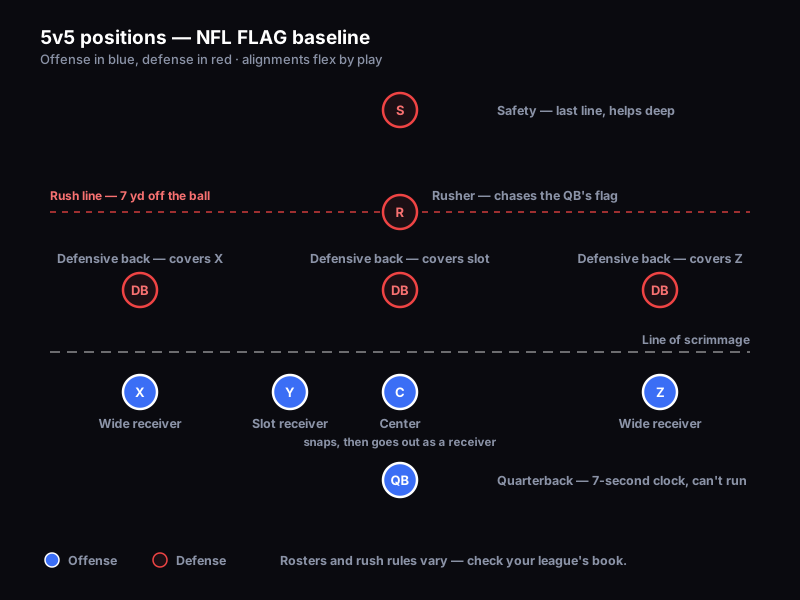
Offensive positions
Quarterback (QB)
The leader of the offense. The quarterback receives the snap and either passes the ball or hands it off. In NFL FLAG the QB cannot run with the ball after the snap and has a 7-second pass clock to get the ball out, so quick decisions and accurate throws matter more than mobility. The QB calls the play, reads the defense, and decides where the ball goes.
Center
The center snaps the ball to the quarterback — and then becomes an eligible receiver. That dual role is unique to flag: the moment the ball is snapped, the center can release into a route. Defenses often ignore the center, which makes a quick toss to them one of the most reliable plays in the game.
Wide receivers
Receivers run routes, get open, and catch passes. A 5v5 offense typically fields two or three receivers at once. Because there's no blocking, separation comes from sharp route-running and good timing with the QB. (See our beginner playbook for the core routes every receiver should know.)
Running back
Some offenses use a running back to take a handoff or catch out of the backfield. The key rule: running plays aren't allowed within 5 yards of midfield or the end zone (the no-run zones), so a back's value is in mixing runs with short receptions where running is legal.
Defensive positions
Defensive back (DB)
Defensive backs cover receivers, either man-to-man or in a zone. Their job is to stay with their assignment, pull flags, and pick off errant throws. In youth flag, good DB play is mostly about positioning and not biting on fakes.
Rusher
The rusher is flag football's version of a pass rusher. In NFL FLAG, the rusher must line up at least 7 yards off the line of scrimmage and can cross once the ball is snapped, racing to pull the QB's flag before the 7-second clock expires. A maximum of two designated rushers may legally rush the quarterback.
Safety
The safety plays deeper than the rest of the defense and is the last line against a big play. They read the field, help over the top on deep routes, and clean up anyone who slips through coverage.
How positions change with format and age
The roles above are the NFL FLAG 5v5 baseline. In 7v7 there are more bodies, so you'll see extra receivers and defenders and more structured line play. In youth divisions, coaches often simplify — a quarterback, two receivers, and a defense focused on "don't give up the big play." Always defer to your league's rulebook for roster size and any position-specific rules.
Picking the right position for a player
- Accurate, calm, quick decisions → quarterback.
- Fast and good hands → wide receiver.
- Smart and reliable → center (snap plus a sneaky receiving role).
- Quick burst off the line → rusher.
- Disciplined and aware → defensive back or safety.
Frequently asked questions
How many positions are there in 5v5 flag football?
Five players per side, but roles flex by play. A common setup is QB, center, and receivers on offense; defensive backs, a rusher, and a safety on defense.
Can the quarterback run in flag football?
In NFL FLAG, no — the QB can't advance the ball by running after the snap and must pass or hand off within the 7-second clock. Some leagues differ, so check your rulebook.
Is the center allowed to catch a pass?
Yes. After snapping, the center becomes an eligible receiver and can run a route — a frequently open option many teams overlook.
Know the roles — now run the game
ReadyRef tracks every player's touches, catches, and flag pulls by position, so you can see who's producing and put the right people in the right spots.