
Flag football field dimensions: 5v5, 7v7, and youth sizes
Setting up a field or just curious how big it is? Flag football fields are smaller than tackle fields and vary by format and age. Here are the standard sizes — using NFL FLAG as the primary reference since rules differ between leagues — plus the zones and markings that actually affect play.
- The standard NFL FLAG 5v5 field is 30 yards wide by 70 yards long, including two 10-yard end zones.
- That leaves a 50-yard field of play with a midfield line as the line to gain.
- No-run zones sit 5 yards before each end zone and on each side of midfield.
- 7v7 and high-school fields are generally larger; youth fields are often scaled down.
- Always confirm with your league — dimensions and markings vary by organization and age group.
The standard NFL FLAG 5v5 field
Per NFL FLAG, the official 5-on-5 field is 30 yards wide and 70 yards long. The 70 yards includes two 10-yard end zones at each end, which leaves a 50-yard field of play in the middle. There's a midfield line that serves as the line to gain — teams work toward it rather than measuring out individual yardage.
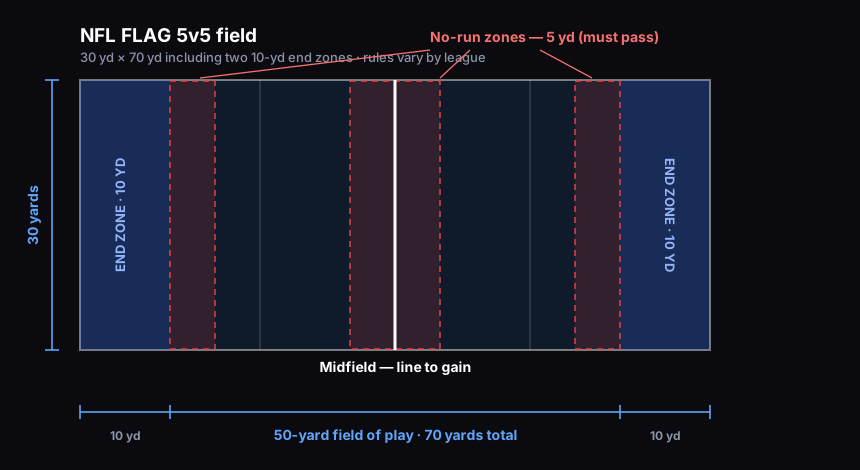
Zones and markings that matter
- End zones: 10 yards deep at each end.
- Midfield line to gain: the offense's first-down target on its opening series.
- No-run zones: the 5 yards before each end zone and 5 yards on each side of midfield. When the ball is in a no-run zone, the offense must pass — no running plays. (More on this in our rules guide.)
How possessions work on this field: teams typically start at their own 5-yard line, get four downs to cross midfield for a first down, then three downs to score from there.
How other formats compare
The 5v5 field above is the NFL FLAG baseline. Other common setups:
- 7v7: generally played on a larger field — often closer to 40 yards wide and up to 80 yards long with 10-yard end zones — to give the extra players room.
- High school (NFHS): sizes are set by the state/association and tend to run larger than 5v5 rec fields.
- Youth: often scaled down so younger players can cover the field; some rec leagues use roughly 25–30 yards wide by 60–70 yards long.
Because these vary so much, treat NFL FLAG 5v5 as the reference and check your specific league's rulebook for the exact field and markings.
Quick-reference table
- NFL FLAG 5v5: 30 yd wide × 70 yd long · two 10-yd end zones · 50-yd field of play · midfield line to gain.
- Typical 7v7: ~40 yd wide × ~80 yd long · two 10-yd end zones.
- Typical youth/rec: ~25–30 yd wide × ~60–70 yd long · two 10-yd end zones (varies).
Setting up your own field
For a pickup or practice field, cones at the corners and along the sidelines are enough. Mark the two end-zone lines, the midfield line to gain, and the no-run zones (5 yards out from midfield and each end zone). If you're running organized games, match your league's official dimensions so play and scoring stay consistent.
Frequently asked questions
How big is a flag football field?
The standard NFL FLAG 5v5 field is 30 yards wide by 70 yards long, including two 10-yard end zones — a 50-yard field of play. Other formats and youth leagues vary.
How long is a flag football field without the end zones?
On the NFL FLAG 5v5 field, the field of play is 50 yards, with a 10-yard end zone added at each end for 70 yards total.
What are no-run zones on the field?
Areas 5 yards before each end zone and on each side of midfield where the offense must pass instead of run — they stop teams from simply powering the ball across short lines.
Field's set — keep score the easy way
ReadyRef handles downs, the line to gain, and no-run-zone timing for you, so the field you set up plays exactly by the rules you chose.