
How to start a youth flag football league: a step-by-step plan
Flag football is booming — it's in the 2028 Olympics and youth participation keeps climbing — but plenty of towns still don't have a league. If yours is one of them, here's the full launch plan: demand, money, insurance, fields, teams, rules, and the season itself.
- Prove demand before you spend: 40–60 committed kids is enough for a two-division first season.
- Registration fees fund the league — set them after you've priced fields, insurance, equipment, and refs.
- Insurance and background checks aren't optional for youth sports; handle them early.
- Adopt an existing rulebook (NFL FLAG is the common baseline) instead of writing your own from scratch.
- Communication is retention: a public schedule, live scores, and standings keep families engaged and coming back.
Step 1: Prove there's demand
Before permits and logos, get names on a list. Post in local parent groups, ask schools and existing sports clubs, and run a simple interest form. You're looking for roughly 40–60 committed kids — enough for two age divisions of 4–6 teams playing 5v5. Decide your scope now: which ages, which format, and how long a season. Our age groups guide covers how leagues typically split divisions.
Step 2: Decide affiliated or independent
NFL FLAG affiliation gives you a recognized rulebook, branding kits, and equipment bundles — useful credibility for a first-year league. Staying independent means full control over rules, fees, and structure. Either way, write down which rulebook you use (see rules explained) and publish it where every coach and parent can find it.
Step 3: Build the budget and set fees
Typical first-season costs:
- Equipment: flag belts, footballs (sized by age), cones, and a first-aid kit — see the equipment guide.
- Fields: permit fees for a municipal field or school rental.
- Insurance: general liability plus accident coverage.
- Jerseys or pinnies: the single most-loved line item — kids keep them.
- Referees: volunteer, honorarium, or paid teens — budget it either way.
Add it up, divide by expected registrations, add a cushion, and you have your fee. Collect a small deposit at sign-up — free interest evaporates; paid interest shows up on Saturday.
Step 4: Insurance, sanctioning, and safeguarding
Youth sports need general liability insurance and accident/medical coverage, and most cities require proof before issuing field permits. Volunteer background checks are standard practice for anyone coaching kids. This is the least fun step and the one that protects everything else — do it before you announce a season.
Step 5: Lock in fields
A 5v5 field is 30 × 70 yards (see field dimensions) — one full-size soccer field can host two flag games side by side. Book more time than you think you need: makeup weeks disappear fast. Confirm what's included (lines, goals out of the way, washroom access) and whether you can paint or cone your own markings.
Step 6: Registration and team formation
Keep sign-up simple: an online form, a fee, and a waiver. Then form teams deliberately — a draft or skill-balanced assignment beats "friends sign up together" for competitive balance, though many young divisions allow buddy requests. Cap rosters (8–10 for 5v5) so every kid plays meaningful snaps.
Step 7: Recruit coaches and referees
Parents are your coaching pool — arm them with the coaching guide, a practice plan, and a short rules session before week 1. Referees can be trained teens or adults; our refereeing guide covers the fundamentals. Pay or thank them properly — ref churn is a league-killer.
Step 8: Schedule the season
A first season that works: 7–8 regular-season weeks (round robin), one makeup week, then a single-elimination playoff. Build it with the schedule maker guide or let ReadyRef's Season Wizard generate it around your fields, time slots, and referees with conflicts flagged before publishing.
Step 9: Run game days that feel big-league
This is where retention is won. Live scoreboards, real standings, and a schedule families can check from their phone make a first-year league feel established. With ReadyRef, refs run the game from a phone, every game gets a free browser watch link for family who can't make it, and finals roll into standings automatically. Every league also gets a free public league site at readyref.app/leagues/your-league — see a real one at Bluewater Flag Football.
Step 10: Close the season loudly
A championship day with a proper bracket, medals or photos, and a "register for next season" push while excitement is high. Leagues grow season over season on word of mouth — give families something to talk about.
A realistic 12-week launch countdown
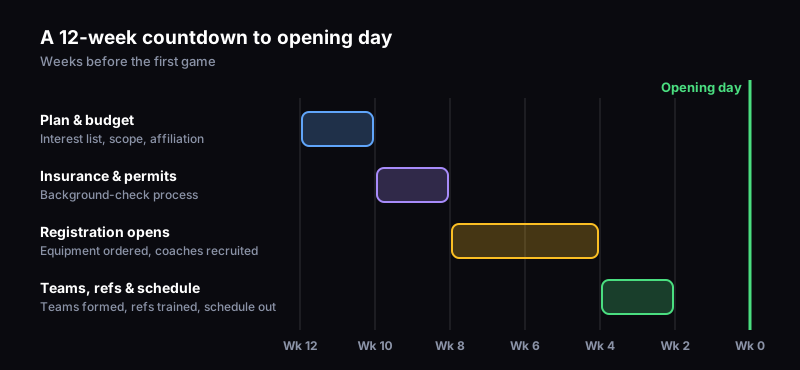
- Weeks 12–10: interest list, scope, budget, affiliation decision.
- Weeks 10–8: insurance, permits, background-check process.
- Weeks 8–4: registration open, equipment ordered, coaches recruited.
- Weeks 4–2: teams formed, refs trained, schedule published.
- Week 0: opening day — scoreboard on, watch links out, season live.
Frequently asked questions
How much does it cost to start a youth flag football league?
A modest first season can launch for a few thousand dollars, funded by registration fees — 60 kids at $80–120 typically covers equipment, fields, insurance, and refs. Regional costs vary widely.
How many teams do I need?
Four per division is the workable minimum; six to eight is comfortable. Combine adjacent ages rather than running a tiny division.
Do I need insurance?
Yes — liability plus accident coverage, usually required before you can even book fields.
Launch with the game-day side handled
Schedule, live scoreboards, standings, brackets, and a league website — so your first season runs like your fifth.