
How to make a flag football schedule (by hand or with a generator)
A league schedule looks simple until you try to build one: every team needs a fair mix of opponents, fields and time slots are limited, referees can't be in two places, and one rainout can knock over the whole board. Here's the round-robin math, how to build a schedule in a spreadsheet, and what a schedule maker should automate for you.
- A single round robin needs n−1 rounds for n teams (add a bye if n is odd) and n(n−1)/2 games total.
- The "circle method" generates fair matchups by hand: fix one team, rotate the rest each round.
- Matchups are the easy part — fields, time slots, refs, and byes are where hand-built schedules break.
- Track game statuses (scheduled, final, postponed, canceled, forfeited) or your standings will drift from reality.
- Decide your rainout policy before week 1, not during the storm.
Start with the math
For n teams playing a single round robin (everyone plays everyone once):
- Rounds: n−1 if n is even; n if n is odd (each team sits out once as a bye).
- Total games: n(n−1)/2. Eight teams = 28 games; ten teams = 45 games.
- Games per round: n/2. With 8 teams that's 4 games a week — two fields with two time slots each covers it.
Want everyone to meet twice? Double round robin doubles everything. Our format comparison covers when each is worth it.
The circle method, by hand
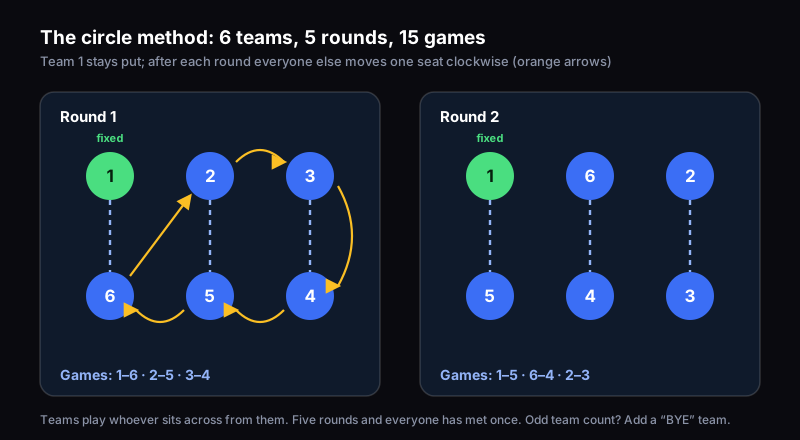
The classic way to generate a round robin without repeats:
- Number your teams 1 through n (add a "BYE" team if n is odd).
- Put team 1 in a fixed seat. Arrange the rest in a circle.
- Each round, pair teams across the circle: 1 plays whoever is opposite, 2 plays the next pair across, and so on.
- After each round, rotate every team except team 1 one seat clockwise. Repeat n−1 times.
That gives you fair matchups. Want to skip the hand work? Our free schedule maker runs the circle method for you, adds dates, fields and time slots, and prints the result. Now comes the part the circle method doesn't solve.
Where hand-built schedules break
- Field conflicts: two games assigned to the same field and slot. Easy to miss across a 28-game grid.
- Referee conflicts: a ref assigned to simultaneous games, or a ref who also coaches a team scheduled at the same time.
- Accidental double-headers: a team playing back-to-back slots — fine if intentional, brutal for families if not.
- Bye clumping: one team drawing its byes three weeks in a row.
- The reschedule cascade: one rainout replayed in a "free" slot that quietly creates two new conflicts.
In a spreadsheet, catching these means manually cross-checking every column after every change — the Sunday-night job every organizer learns to dread.
What a schedule maker should automate
Whatever tool you use, it should take your constraints — teams, fields, time slots, referees, format — and produce a schedule that respects them, then keep it honest as the season changes. ReadyRef's Season Wizard does exactly this: pick a format (round robin through playoff brackets), set your fields and time ranges, assign referees, and it flags conflicts before you publish. Game statuses are first-class — postponed and forfeited games are marked, not fudged — and finals flow straight into standings so nothing needs recalculating. Every game also gets a live watch code, and every plan, including Free, can publish the schedule to a public league site families can bookmark.
Publishing and keeping it current
A schedule only works if people can find the current version. Whatever you build, put it at a stable link (not a screenshot in a group chat), show statuses clearly, and update standings the same night finals come in. If you're weighing the fully manual route against software, our guide to running a league and the league software comparison lay out both paths.
Frequently asked questions
How many weeks does a round robin take for 8 teams?
Seven rounds — n−1 for n teams. With two fields running in parallel, that's a 7-week season with four games each week.
Is there a free flag football schedule maker?
Free round-robin generators handle matchups fine. The hard 20% — fields, refs, byes, and reschedules — is what purpose-built tools automate.
How do I handle rainouts?
Decide before the season: build makeup weeks into the calendar, or mark games postponed and replay them in the first genuinely free slot. Track statuses explicitly so standings stay truthful.
Let the Season Wizard build it
Teams, fields, time slots, refs, format — in, one conflict-free schedule out, with standings that update themselves as finals come in.