
Flag football routes: the route tree explained
A good passing game starts with a small set of clean routes everyone knows by name. This is the flag football route tree — the slant, hitch, out, post, corner, and go — explained in plain language, with which ones beat man, which beat zone, and how to teach them to beginners.
- A route tree gives your team shared names so the QB and receiver see the same play.
- Beginners only need four: slant, hitch, out, and go.
- Sharp breaks beat man; sit-down routes beat zone.
- Sell the route — run every one at full speed until the break.
- Pair routes that stretch the defense high and low on the same play.
What a route tree is
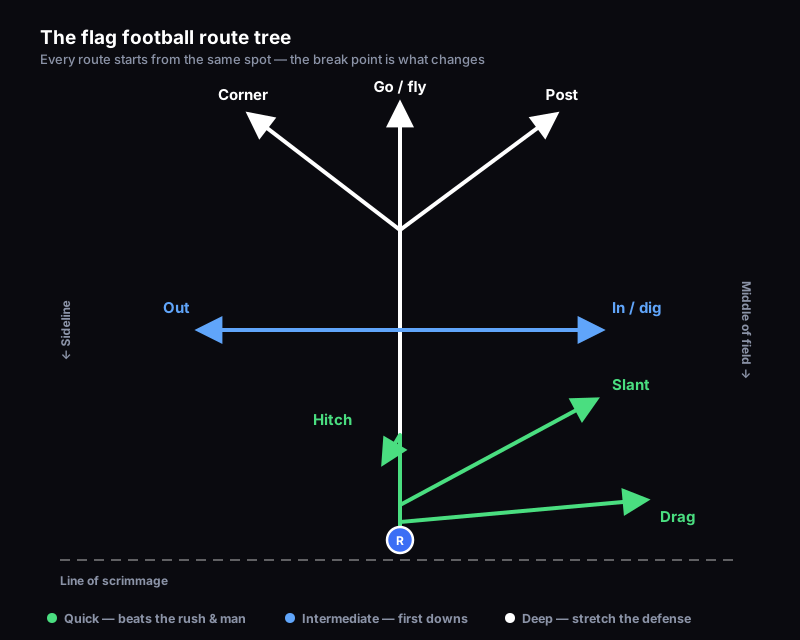
A route tree is just a diagram of the standard paths a receiver can run from one starting spot — short and flat at the bottom, deep and vertical at the top. Naming them matters more than the diagram: when you call "slant," the quarterback and receiver should picture the exact same break. That shared vocabulary is what lets a play work without a long huddle. If you put plays on a wristband play sheet, these names are what you'll write on it.
The core routes
- Hitch (stop/curl). Sprint 5 yards, plant, and turn back to the QB. The easiest completion in flag football and a great answer to a soft cushion.
- Slant. Take two or three steps upfield, then cut at a 45° angle across the middle. Quick-hitting and tough to cover one-on-one.
- Out. Push upfield 5–7 yards, then break sharply toward the sideline. Safe because the ball goes where only your receiver can get it.
- In / dig. The mirror of the out — break hard to the middle. Opens up over the ball when the defense respects the sideline.
- Corner (flag). Sell a vertical stem, then break at 45° toward the front corner. A primary deep-ball route in 5v5.
- Post. Stem vertical, then angle toward the goalposts/middle. Great when a safety is shaded outside.
- Go (streak/fly). Straight upfield, run past the defender. Even when it's covered, it clears space underneath for everyone else.
- Drag / cross. A shallow route across the field. Reliable yardage and perfect against man coverage and blitzes.
Which routes beat which coverage
Match the route to what the defense is doing — for the defensive side of this, see best defense for 5v5.
- Vs. man: sharp-breaking and crossing routes win — slants, outs, corners, and drags create separation at the break.
- Vs. zone: sit-down routes win — hitches and curls settle into the open windows between defenders.
- Vs. a deep safety: attack underneath with hitches and outs, and use the post to hold the safety honest.
Combining routes
One route rarely beats a good defense; a combination does. Pair a deep route with a short one in the same area so the QB has a high-low read: if the defender drops, throw the hitch; if they jump it, throw the corner behind them. A simple, proven combo is a go on the outside with a slant inside — the go clears out the deep defender and the slant works the space it leaves. Build a few of these into your beginner plays.
Teaching routes to beginners
- Count the steps. Give every route a step count so breaks happen at the same depth every time.
- Run full speed until the break. A route only works if it looks like a go until the cut.
- Snap the head around. Eyes find the ball the instant the break is finished.
- Drill it cold. Air routes and one-defender reps build the timing — see drills for kids.
Frequently asked questions
What are the basic flag football routes?
The core routes are the slant, hitch, out, in/dig, corner, post, and go (streak). Most beginner offenses can run an effective passing game with just the slant, hitch, out, and go.
What routes beat man coverage?
Sharp-breaking routes that create separation beat man coverage — slants, outs, and corners — along with anything that uses a quick change of direction. Against zone, sit-down routes like the hitch and curl that find the open space work best.
What is a route tree?
A route tree is a diagram that numbers the standard pass routes a receiver can run from a single starting point, from short and flat to deep and vertical. It gives a team shared names so the quarterback and receiver picture the same play.
Call the game, not just the play
ReadyRef keeps score, downs, and the clock in sync while you focus on the sideline — so you can coach the routes instead of juggling a clipboard.