
Settle the argument · 0:47

In the rusher’s way?

It depends on one thing: did they signal? A blitzer with a raised hand has right of way. A rusher without one doesn’t. And standing still is never shielding.

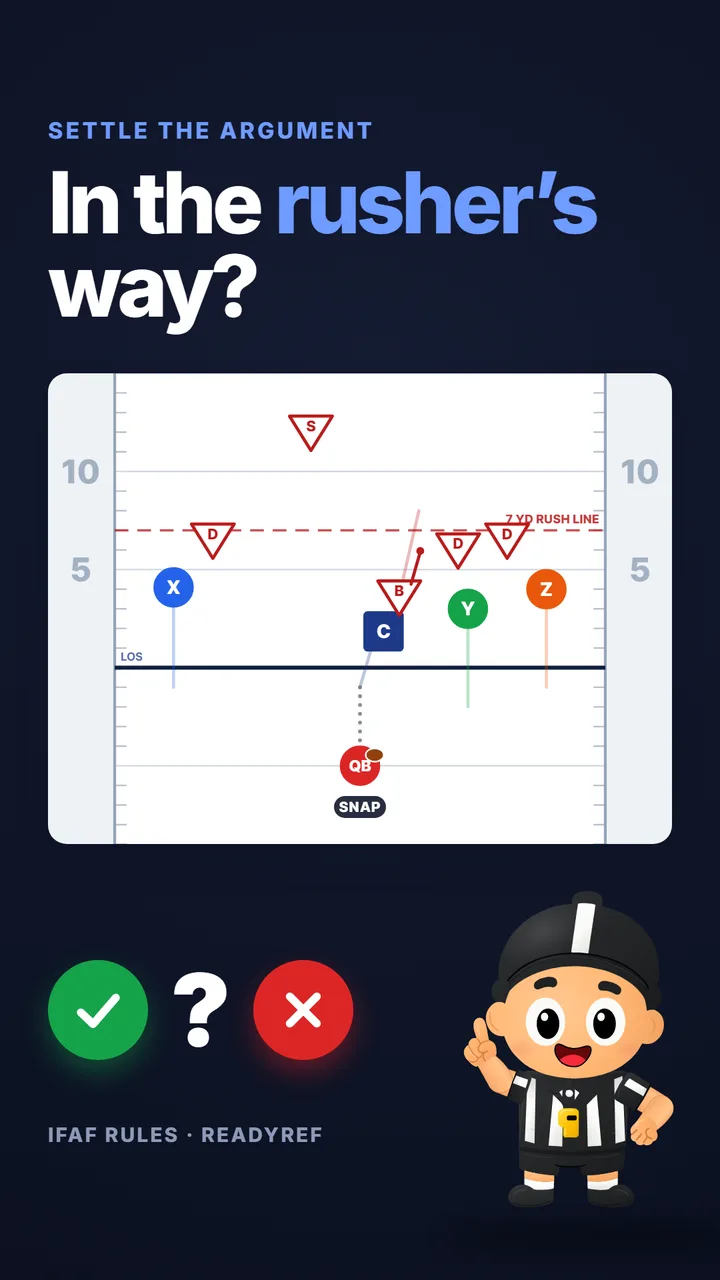
Video poster: In the rusher’s way? A play diagram of the center stepping into a blitzer’s lane, a green check and a red X, and a cartoon referee.

Plays from YouTube when you press play.

Jump to

The call, step by step

  1. 0:03It depends: did they signal?
  2. 0:06A signalled blitzer has right of way
  3. 0:16The penalty: offense
  4. 0:23No signal: shielding by the defense
  5. 0:34Standing still is never shielding
Read the transcript

The rusher’s coming. Can a receiver step into their path? It depends on one thing: did they signal?

A deep defender who raises a hand before the snap, then rushes quick and straight at the quarterback, has right of way. Cut across that lane and it’s shielding, even with no contact. The call: five yards against the offense, from the line of scrimmage, and the down is repeated.

A rusher who didn’t signal gets no right of way. If they force a receiver off their route, the shielding is on the defense: five yards, and the down is repeated. And a player standing still is never shielding.

Got another argument? Settle it at readyref.app/rules.

Good to know

  • The penalty: shielding, 5 yards, signal S43 (IFAF Rule 9-2-2-a). It’s measured from the basic spot: for the offense, the line of scrimmage, or the spot of the foul if it was behind the line; for the defense, the line of scrimmage, or where the play ended if that was past it. The down is repeated, unless the penalty puts the ball past the middle.
  • Who is a blitzer? A defender who lines up more than 7 yards off the line, raises a hand before the snap, and rushes right away, quick and straight at where the quarterback took the snap (IFAF Rule 2-2-6).
  • Right of place beats right of way. A player who is standing still has right of place, so a blitzer has to go around them (IFAF Rule 2-13-1).
  • No contact needed. Shielding is moving into an opponent’s path to obstruct them, even without touching them (IFAF Rule 2-11-2).

More arguments, settled

Short answers to the calls that start sideline arguments, each with the IFAF rule behind it.

Previous: Can you lateral? · All how-to videos · All rules answers · Rules quiz